Terminal Crimp Quality is one of the most critical factors in a wire assembly. Your wire assembly has numerous connection points, and most of them have a connector to facilitate this connection. It only takes one bad connection to render an entire electrical assembly inoperable.
The wire-to-terminal crimp is composed of several elements. Each element has its own process capability. The crimp itself has physical factors which contribute to an acceptable electrical connection and mechanical strength. Crimp Physics are well established and essential to ensure an electrical connection with low electrical resistance and high tensile strength (as demonstrated by pull tests).
Conductor Crimp Height and Pull Test are the two primary measurements used in validating a crimp. Conductor Crimp Width is also an essential factor when considering overall crimp quality. But how does it fit in with these two primary measurement factors?
Crimp Tools are engineered and produced to form a terminal around a wire. Each crimp tool set (Conductor and Insulation punch and anvil) have a profile which produce the desired crimp shape. Wire is pressed into the terminal and the overall height and width assure the conductor strands are deformed at a proper compression ratio while achieving acceptable mechanical strength.
A terminal typically is designed to accommodate a few adjacent wire sizes that can be crimped without compromising electrical integrity or mechanical strength. The crimp applicator has a dial that sets the conductor and insulation crimp height to the rated wire size.
Conductor Crimp Width is not adjustable and is the same for all wire sizes within a terminal’s wire range. Where applicable, crimp height is further adjustable by a shut height adjustment on the press.
Over time, tools wear. As tools wear, the ability to maintain the height and width ratio are compromised. Small adjustments in shut height can compensate for tool wear, but the tool width is fixed. The sides of the crimp tool profile will wear to the point where the crimp height to width ratio is not met.
What are the implications of the Crimp Width being out of Spec?
- Loss of Conductor Compaction
- High Electrical Resistance
- Low Tensile (Pull Test) force.
Maintaining Conductor Crimp Height and Width is critical to assuring the proper conductor compression. Replacing tooling before the crimp height and width are compromised is very important. Despite the tendency to defer to the economics of tool costs and use tooling past their ability to maintain the proper measurements. Deferring to the latter raises the risk of crimp failure in the field.
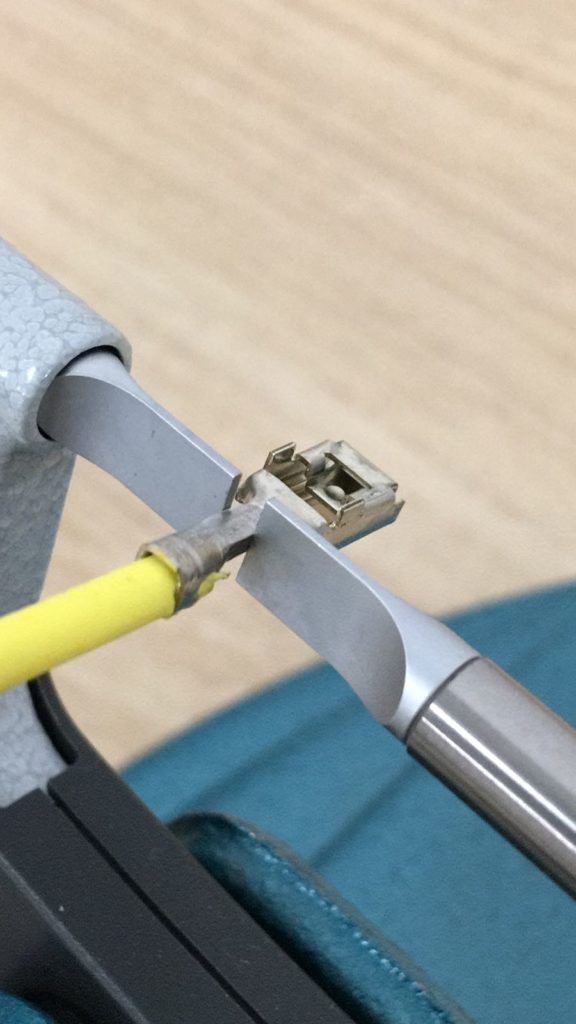
Measuring conductor crimp width should be a parameter that maintenance tracks to determine when tools should be replaced. Conductor Crimp Width is measured using a dial caliper or Blade Micrometer.
A well equipped factory includes well maintained and capable processing equipment. Additionally a well equipped factory should also include validation and monitoring tools to assure repeatable quality. But even the best processing tools and quality tools are completely worthless without adequate worker training. Training is required for all levels of the organization, from management and supervisors to operators and maintenance. Crimping Solutions by WireProcess Specialties provides end to end support for the terminal crimp process. Visit Crimping Solutions or Connect to WireProcess to get started.