Why understanding the technology is just as important as installing it.
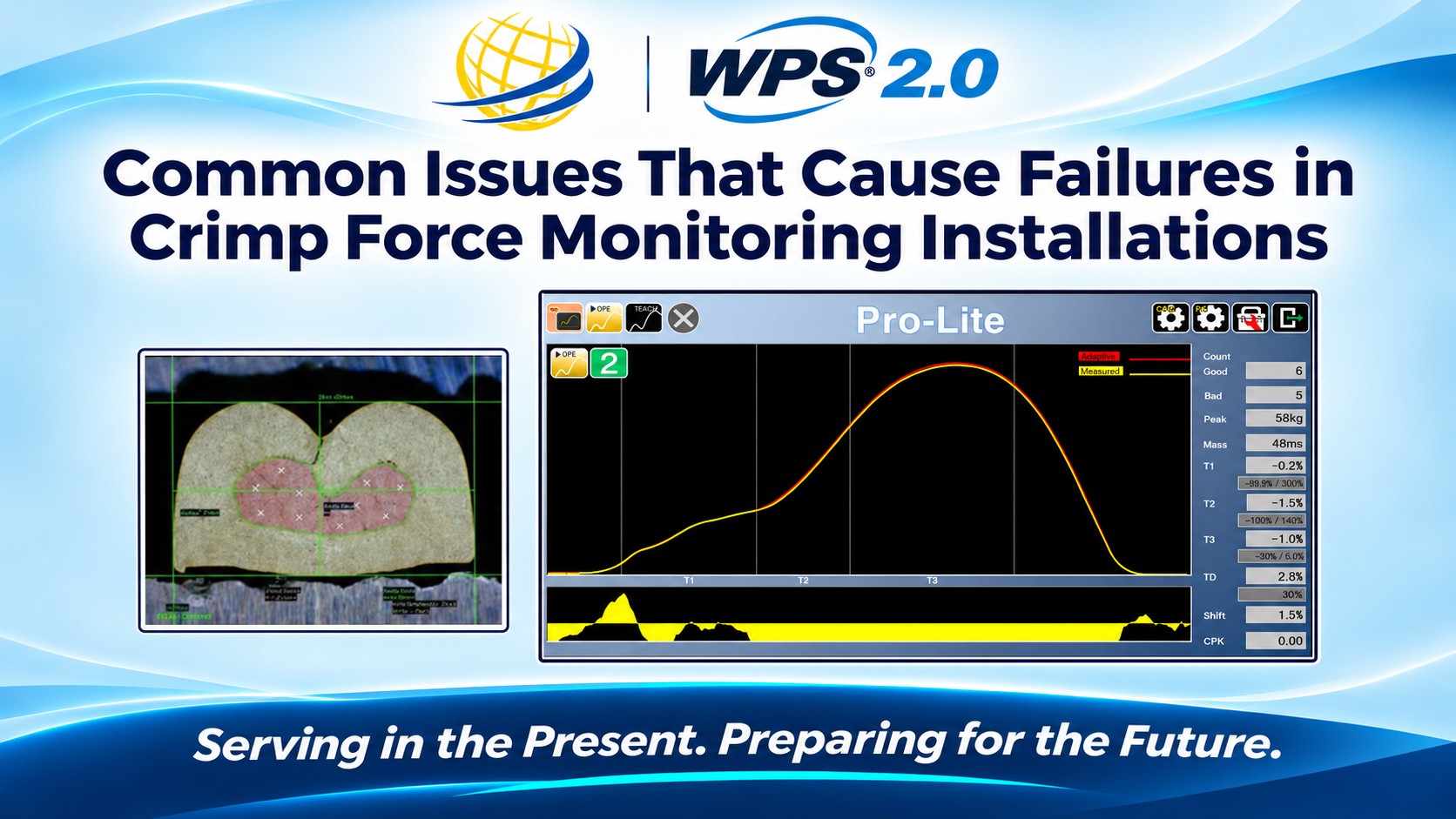
Every seminar I present that addresses Crimp Force Monitoring includes the statement: “Crimp Force Monitors Expose, But Do Not Solve Your Quality Problems. That is your job.” This two part article expands on this statement and uncovers the issues that can cause failures in your installation and how to avoid these issues.
Addressing the Misconceptions of a Crimp Force Monitor Installation
Companies enter a Crimp Force Monitoring program expecting a Crimp Force Monitor (CFM) to solve a quality problem. The reality is that the CFM can trigger numerous crimp alarms, and companies often start by blaming it. This leads to the monitor being switched off without understanding the core reasons for the alarms themselves.
Installing a CFM does not automatically guarantee improved crimp quality.
Unsuccessful CFM implementations are generally caused by a misunderstanding of how the technology works, what it measures, and what constitutes an acceptable crimp. Simply put, a CFM is a reference tool that compares the production of crimps with a “teach-in” of a reference sample of validated crimps. When a crimp moves outside of the defined tolerances, a crimp alarm occurs.
A CFM does not directly measure crimp height, electrical resistance, mechanical pull strength, or the internal compression of wire strands. These measurements are critical ingredients for a reliable electrical connection and are used to validate a crimp. In fact, Crimp Force Monitoring is not a substitute for validating the finished crimp connection.
The Importance of Establishing a Good Reference
As mentioned, CFM systems generally compare production cycles against a reference established during setup. But what happens if the reference crimp is not properly validated? The monitoring system may accept crimps that do not meet the required specifications or trigger constant crimp alarms, as the observed production results are spread outside the defined tolerances.
Prior to performing a teach in, the crimping process should be evaluated using appropriate quality measurements, including:
- Crimp height and dimensional verification.
- Mechanical pull-force testing.
- Visual inspection of the crimped connection.
- Cross-section analysis to evaluate internal compression and deformation.
These measurements help establish higher confidence that the monitored process can produce acceptable connections. In the case of Cross-Section analysis, it provides clues that contribute to crimp alarms in production and long-term electrical performance.
Understanding Crimp Monitor Sensitivity
Detection capability can be influenced by wire size and terminal match, tooling condition, crimp press repeatability and operator wire presentation. For example, detecting missing wire strands as a defect element is directly influenced by these elements; excessive process variation can make the detection process less sensitive.
The ability to detect a specific defect should be demonstrated through controlled testing rather than assumed.
The First Step Toward Successful Implementation
Successful CFM implementation begins with understanding the technology and establishing a properly validated crimping process.
Training helps operators, technicians, and quality personnel understand what the monitoring system is communicating and how to respond when the process changes.
Laboratory testing provides additional evidence that the crimping process meets the required quality criteria.
Together, these activities establish a stronger foundation for effective process monitoring.
In Part 2, we will examine how improper setup, inadequate training, and insufficient validation can undermine CFM performance—and how manufacturers can address these challenges.


